January 2026 very wet in mainland Portugal and the 5th warmest globally
Globally
Globally, January 2026 was +0.51 °C warmer than the 1991–2020 average, with a mean near-surface air temperature of 12.95 °C, making it the 5th warmest January on record.
It was +1.47 °C above the estimated average for the 1850–1900 period (pre-industrial level).
Europe
The average air temperature in Europe in January was −2.34 °C, which is −1.63 °C below the 1991–2020 average, making it the coldest January in Europe since 2010.
Widespread cold conditions occurred across Fennoscandia, the Baltic States and Eastern Europe. In Lapland (Finland), temperatures below −30 °C were recorded, and in Lappeenranta (southern Finland), the coldest night of the winter was observed with a minimum temperature of −31.5 °C.
Monthly mean temperatures were more than 10 °C below normal in both southern and northern Norway, which recorded its 15th coldest January since the start of the series in 1901.
Across the Iberian Peninsula, conditions were wetter than normal across much of western, southern and eastern Europe, according to all indicators. The precipitation signal was particularly pronounced in parts of the United Kingdom and Ireland, the Iberian Peninsula, and the Western Balkans.
Some regions recorded exceptional precipitation for this time of year, at national or local levels. Spain experienced its wettest January in the past 25 years, with stations in Catalonia recording rainfall totals around five times the normal values.
In Portugal, 78% of stations recorded total precipitation at least twice the climatological average. In the United Kingdom, Cornwall recorded its wettest January since records began, dating back to 1877 and 1836, respectively.
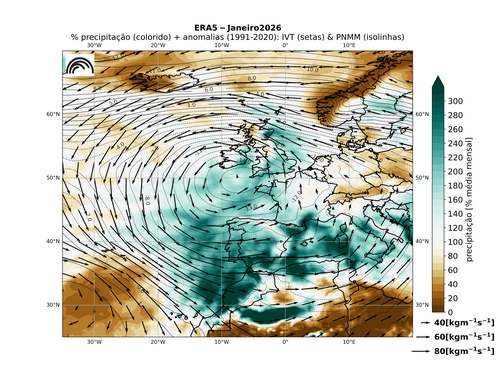
Figure 1. Anomalies (1991-2020 reference period) for mean sea level pressure and humidity transport, as well as rainfall percentages for january 2026. Source: C3S/ERA5
Mainland Portugal
In Portugal, January 2026 was classified as warm in terms of mean air temperature and very wet in terms of precipitation.
Air Temperature
- It was outside of the top 10 warmest Januaries on record, with a mean air temperature of 9.30 °C, which is +0.26 °C above the 1991–2020 normal.
- The mean maximum temperature was 12.82 °C, −0.53 °C below the normal value.
- The mean minimum temperature was 5.78 °C, +1.04 °C above the normal value.
Precipitation
- 2nd wettest January since 2000 and the 14th wettest since 1931.
- All analysed stations recorded precipitation totals above the monthly average.
- At 78% of stations, the total precipitation was at least twice the climatological average, and at 40% of stations totals were 2.5 to 3.5 times the normal value.
Highlights in mainland Portugal
Several low-pressure systems passed over the country, bringing persistent rainfall and snow in mountainous areas of the North and Centre, occasionally strong winds, and rough sea conditions. These included: Storm Francis (2–5 January), Storm Goretti (8–9 January), weather fronts associated with transient depressions northwest of mainland Portugal (13–17 January), Storm Ingrid (23–25 January), Storm Joseph (26–27 January) and Storm Kristin (27–28 January)
During the passage of Storm Kristin, very strong wind gusts exceeding 130 km/h were recorded in the districts of Coimbra, Leiria and Castelo Branco. The highest gust recorded was at the Ansião meteorological station, reaching 172.4 km/h on 28 January at 05:40 UTC.
All municipalities recorded soil water values above field capacity, already reaching soil saturation levels, with some municipalities in the northern interior, the central region and the southern coast very close to full soil saturation.
Have acess to the climate bulletin for January 2026 (portuguese version only): Climate bulletin for January 2026

Figura 2. Flooding in Sorraia river, close to Coruche town (Santarém, Portugal). Picture credit: Carlos Pereira